GB30 main unit
Integrated local GNSS base and NTRIP Caster with a built-in status display.
 RTKGO
Request a quote ↗
RTKGO
Request a quote ↗
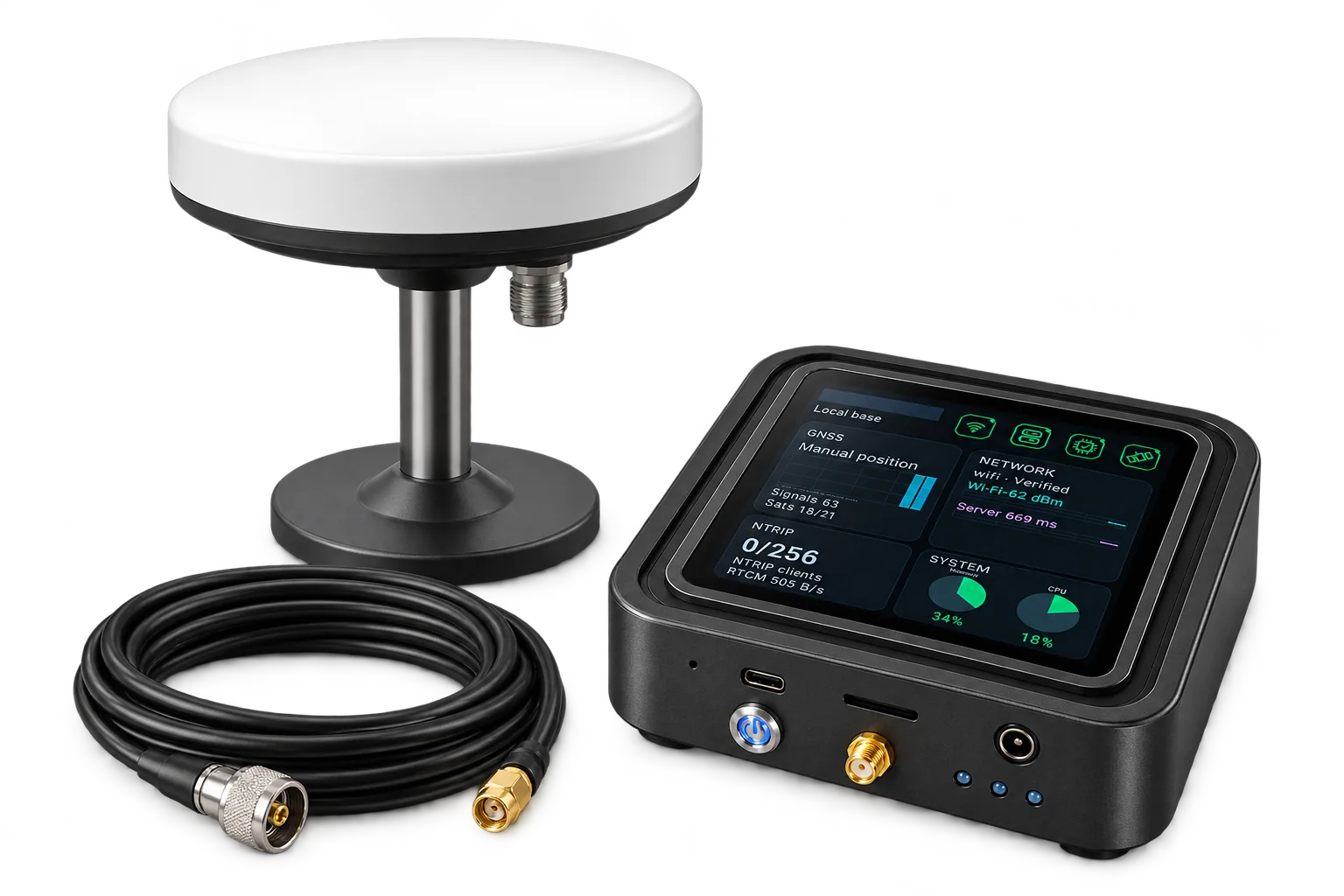
The complete kit: GB30 main unit, external GNSS antenna, mounting stand and coaxial antenna cable.
Open original-size image ↗The kit includes the GB30 main unit, external GNSS antenna, antenna mounting stand and coaxial antenna cable. The compact ARM main unit combines your local reference base and NTRIP Caster. Install the main unit indoors and fix the antenna outdoors.
Project-specific quotation · Configure your GB30 deployment
Network tunnel: no public IP, port forwarding or dedicated line. Internet access and a compatible client are required.
Integrated local GNSS base and NTRIP Caster with a built-in status display.
Fixed outdoor reference observations with clear sky visibility.
The antenna support shown in the complete-kit product view.
Connects the outdoor antenna to the main unit antenna input.
Confirm cable length, connector requirements and mounting requirements in your quotation. Power supply and other installation equipment are specified separately.
Download complete-kit contents ↓Generate the source. Distribute corrections. Connect professional RTK equipment.
Outdoor GNSS antenna.
Indoor GB30, connected by coax to its SMA input.
Its own local source, plus up to eight independent uplink reference sources.
Explore the platform →Handhelds, rovers, machine terminals, robotics and other RTK industry devices.
Choose a field device →Network tunnelling requires internet access and a compatible client.
Generate your own reference data and serve clients from the same GB30. Add independent sources from up to eight uplink GB30 stations.
An 8 + 1 layout provides nine reference points. Approximately 10km station spacing is a planning example; actual coverage requires site validation.
Sources are not fused. Nearby source selection does not imply automatic roaming, VRS or guaranteed coverage.
Use a permanent reference installation for compatible RTK handhelds, rovers, agricultural machines, vehicles, robotics and other industrial positioning systems.
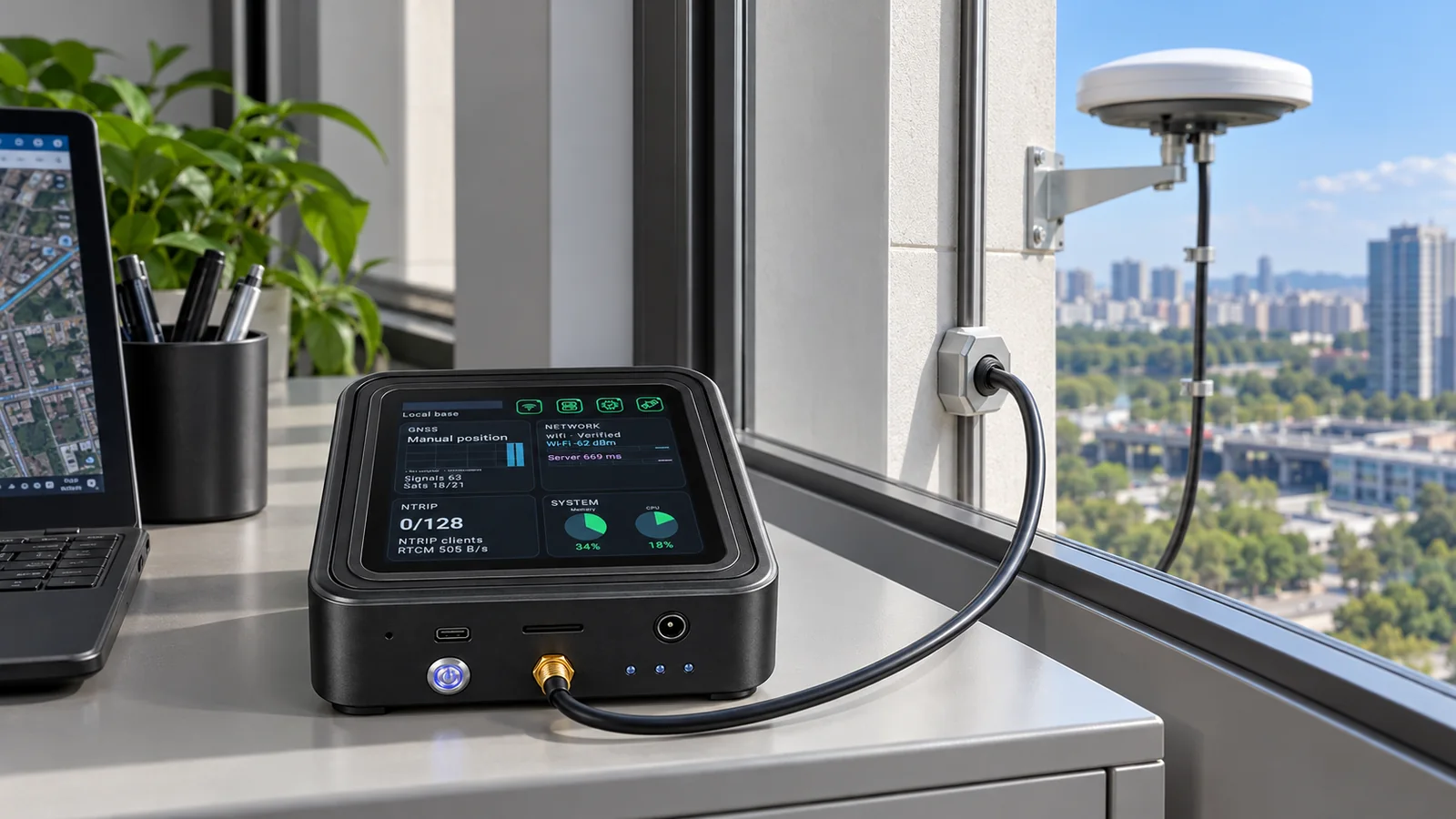
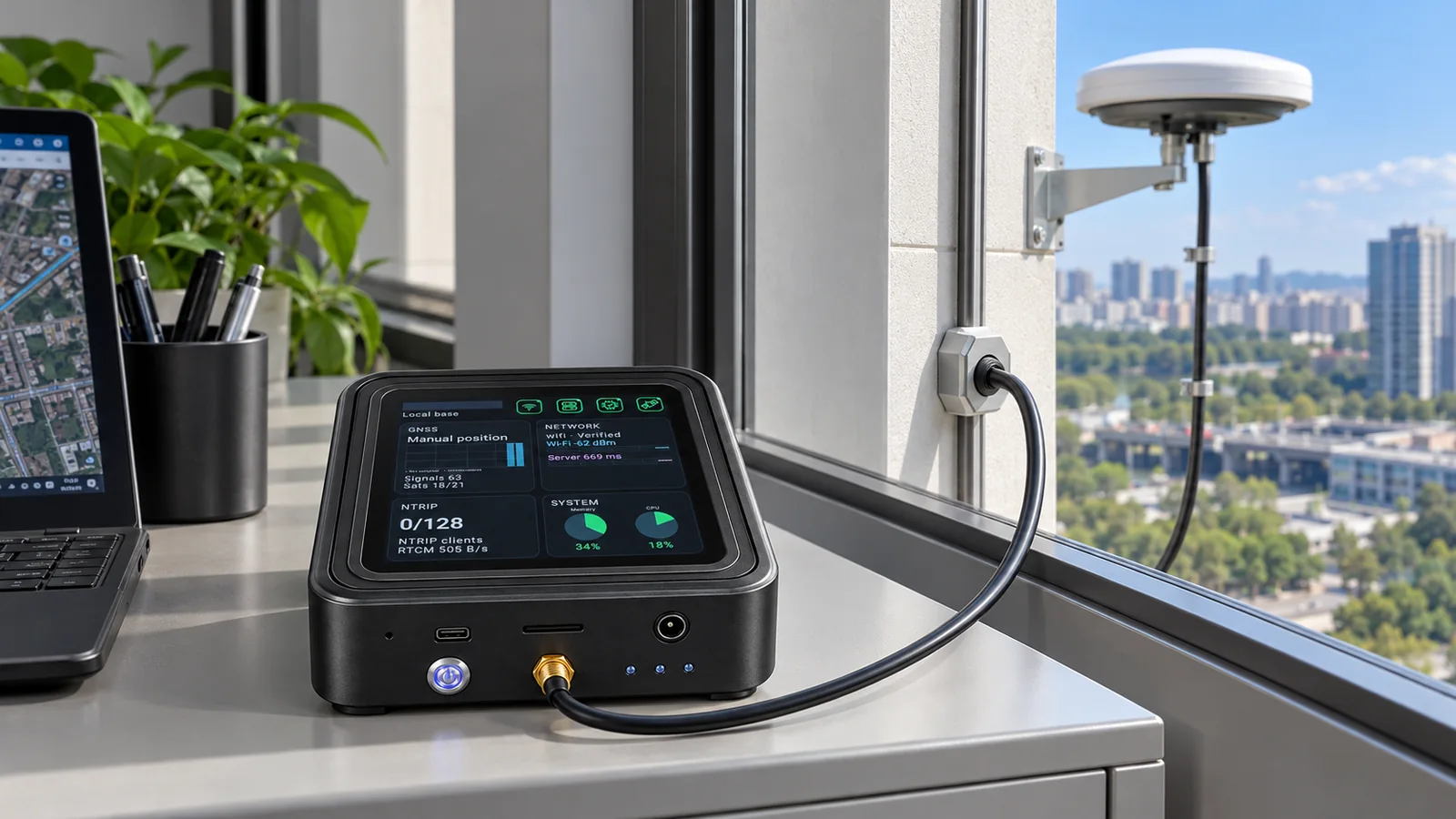
Keep each GB30 indoors at a stable reference location. An outdoor antenna supplies observations while the central local-mode GB30 makes independent sources available to RTK field teams.
Review receiver status, network connectivity, reference sources and client sessions from the GB30 interface.
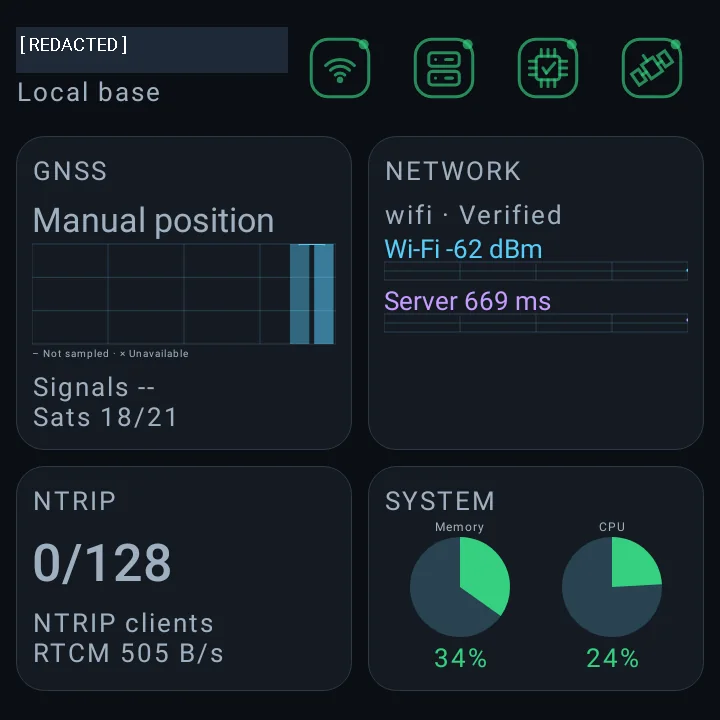
GNSS, network, NTRIP and system information in one view. Check live details before accepting a handover.
The default configuration supports 256 client terminals. On-screen status values vary with the active configuration.
Read the complete user guide →A fixed reference point begins with the right installation.
Mount the GNSS antenna outdoors at a stable reference location with a clear view of the sky.
Route the coaxial cable indoors and screw it onto the GB30 antenna SMA connector.
Connect to an available network, choose the operating role, then check source and client status.
Choose the path for your network environment, client compatibility and intended capacity.
Connect compatible industrial RTK devices through a direct NTRIP connection.
Connect through a tunnel where a dedicated public network setup is unavailable.
GB30 integrates the local reference and Caster roles. Compare the complete hardware, power, network and maintenance scope for your project.
| Decision point | GB30 integrated approach | Separate base + PC / server Caster | Separate base + hosted Caster |
|---|---|---|---|
| Hardware scope | Local base + Caster in one ARM device | Receiver / base plus a separate computing host | Receiver / base plus a hosted service |
| Power scope | 1.5W typical / 2W full load for GB30 | Include the base and selected host | Include the base; service infrastructure is external |
| Network setup | Tunnel avoids a dedicated public IP and port forwarding | Depends on server location and access architecture | Depends on the service and source-upload method |
| Operating cost | Device, network, installation and any service terms | Base, host, software, network and maintenance | Base, network and provider service terms |
| Capacity | Default 256; up to 4,000 direct NTRIP clients under the configured policy | Validate the selected software and host | Check provider policy and service limits |
Power figures cover GB30; account separately for external antennas, network equipment and other installation loads.
Start with one local base / Caster. Add uplink reference points where the project needs independent sources.
Energy = units × 1.5W × 8,760 hours / 1,000. This is a calculation at continuous typical load; external antenna and other unspecified loads are excluded. Capacity belongs to the central Caster and is not multiplied by the number of stations.
Carry this plan into an enquiry ↗Each GB30 kit includes the main unit, external GNSS antenna, mounting stand and coaxial antenna cable. Confirm cable length, mounting requirements, separate power needs, installation, network, service terms, tax and freight. Request a project-specific quotation for the complete deployment scope.
| Product role | Integrated GNSS local reference base + NTRIP Caster |
|---|---|
| Included in each complete kit | GB30 main unit; External GNSS antenna; Antenna mounting stand; Coaxial antenna cable |
| Computing platform | Low-power ARM processor |
| Local Base Station mode | Own reference source and active Caster; accepts independent uplink sources |
| Uplink Base Station mode | Uploads an independent local source to a bound Caster; its own Caster is disabled |
| Default client policy | 256 simultaneous client terminals |
| Default uplink allowance | 8 uplink reference stations |
| Available reference sources | 1 local source + up to 8 independent uplink sources in the described 8 + 1 configuration |
| Maximum direct NTRIP clients | Up to 4,000 simultaneously online; a raised limit/configuration is distinct from the default policy |
| Network tunnel | No dedicated public IP, port forwarding or dedicated line required; internet access and a compatible client remain necessary |
| Tunnel capacity | Confirm for the selected deployment; the direct NTRIP maximum does not apply |
| Network setup | Wi-Fi setup through Android settings is documented; confirm supplied network hardware/configuration |
| Reference coordinates | Survey-in or known fixed coordinates; verify reference frame, height type and antenna reference |
| Source access | NTRIP sourcetable discovery and mountpoint selection; local and uplink sources remain separate |
| Initial pairing | Six-digit code valid for 15 minutes; a valid binding survives code expiry |
| Monitoring interface | Touchscreen; GNSS, network, NTRIP and system cards; clients and uplink sessions monitored separately |
| Configuration management | Separate profiles by mode; save and Apply to device are separate operations |
| Typical / full-load power | 1.5W / 2W |
| Energy at continuous typical load | 13.14 kWh/device/year at 1.5W for 8,760 hours (calculated) |
| Antenna connection | Outdoor fixed GNSS antenna; coaxial cable connects to the main unit's SMA antenna input |
| Installation | Main unit fixed indoors with stable power; antenna fixed outdoors with clear sky |
| Documentation baseline | English user guide 1.0.34; match configuration to installed firmware |
Input electrical rating and power supply · GNSS receiver, constellations, frequencies and output configuration · Dimensions, weight, operating temperature and protection rating · Antenna cable length and connectors, mounting requirements and separately specified power supply · Tunnel compatibility, capacity and service conditions · Shipping firmware, client policy and access configuration.
Confirm the required client capacity, firmware, power supply and installation accessories when requesting your configuration.
Capabilities, power, operating roles and installation requirements.
Download English PDF ↓PDF / SOFTWAREStartup, reference coordinates, pairing, source access and diagnostics.
Download user guide ↓ZIP / HARDWAREProduct views and enclosure references for installation planning.
Download reference pack ↓TXT / HANDOVERRecord the sites, network path, coordinates, mountpoints and handover checks.
Download checklist ↓Match the reference setup, network and field equipment before deciding quantities.
Yes. In Local Base Station mode it generates its own reference source and runs the Caster. The same Caster can also make independent accepted uplink sources available to clients.
The network tunnel avoids a dedicated public IP, port forwarding and a dedicated line. Ordinary internet access, service reachability and compatible clients remain necessary. Direct NTRIP needs a reachable service on the selected network path.
No. The confirmed default policy is 256 client terminals and 8 uplink stations. Up to 4,000 simultaneous clients applies to direct NTRIP under the configured policy. Confirm the client limit and load conditions for your project.
The hub exposes separate local and uplink sources. Select the appropriate nearby source for the work area. Automatic nearest-source selection, seamless roaming, VRS and source fusion are not established by this layout.
The normal installation keeps GB30 fixed indoors with stable power. Mount the GNSS antenna outdoors, then route coax indoors to the existing SMA antenna connector.
Compatible NTRIP RTK handhelds, field tablets, rovers, agricultural and vehicle positioning terminals, robotic systems and other industrial RTK equipment. Verify protocol, data format, client configuration and tunnel compatibility as applicable.
Include the GB30 main unit, external GNSS antenna, antenna mounting stand and coaxial antenna cable. Confirm cable length, mounting requirements, power supply, network, tunnel/service terms, installation, tax, freight and support conditions separately.
Specify your sites, client count and network environment.